UK food labelling regulations: what your label must show
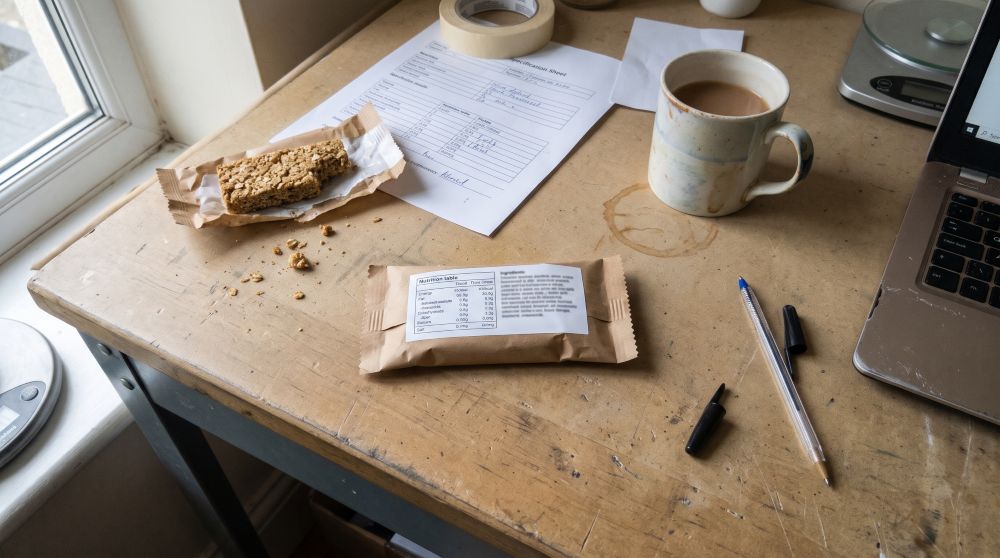
An oat and date bar with nothing artificial in it can still end up with two red traffic lights on the front of pack. Nothing is wrong with the recipe. That's simply what happens once the numbers go through UK food labelling regulations, and most founders only find out when the panel is built and the packaging brief has already gone out.
A UK food label has 12 legal jobs to do, and most of them take a line of text each. The nutrition panel is the one that catches people out, because you can't copy it from your recipe sheet. It has to be calculated, rounded and laid out to a set of rules.
Short answer: UK food labelling regulations require prepacked food to show 12 pieces of mandatory information, set out in Article 9 of retained Regulation (EU) No 1169/2011. Some apply to every product, others (like QUID, country of origin and alcoholic strength) only in certain cases, and the nutrition declaration has its own rules on order, units and rounding.
This post is the checklist, as of October 2026. Each item gets a short explanation and a link to the deeper post where we have one. Then we look at the nutrition panel, and where it usually goes wrong.
Which UK food labelling regulations apply to your product
In Great Britain, the main rulebook is Regulation (EU) No 1169/2011 on food information to consumers, kept in UK law after Brexit and enforced through the Food Information Regulations 2014. You'll see it shortened to FIC or "1169/2011". It's the same regulation behind our post on why fibre sits outside carbohydrate on UK labels.
Northern Ireland follows the EU version of the regulation directly under the Windsor Framework. For most labels the two versions still say the same thing. The differences show up in a few places, mostly the business address and "Not for EU" marking, which we cover below.
Other laws sit alongside FIC for specific jobs: nutrition and health claims (Regulation 1924/2006), lot marking, and the health mark on products of animal origin. They're outside the scope of this post, but they end up on the same pack.
The 12 things a UK food label must show
These are the mandatory food labelling requirements for prepacked food, in the order Article 9 lists them. The GOV.UK guide to what you must show covers the same ground in less detail.
| # | What | Applies to |
|---|---|---|
| 1 | Name of the food | All prepacked food |
| 2 | Ingredients list | Foods with two or more ingredients |
| 3 | Allergens, emphasised in the ingredients list | Foods containing any of the 14 allergens |
| 4 | QUID (quantitative ingredient declaration) | Ingredients named or pictured on pack, or essential to the product |
| 5 | Net quantity | Packs over 5g or 5ml |
| 6 | Best before or use by date | All prepacked food, with limited exemptions |
| 7 | Storage conditions or conditions of use | Where the food needs them |
| 8 | Business name and address | All prepacked food |
| 9 | Country of origin | Where leaving it off could mislead, plus specific foods |
| 10 | Instructions for use | Where the food would be hard to use without them |
| 11 | Alcoholic strength | Drinks over 1.2% alcohol by volume |
| 12 | Nutrition declaration | Most prepacked food, with exemptions |
1. Name of the food
Use the legal name if one exists, otherwise a customary name, otherwise a descriptive one. A brand name doesn't count on its own, so a bar sold under a brand name still needs a description like "oat and date bar" next to it.
2 and 3. Ingredients and allergens
List every ingredient in descending order of weight at the time it went into the mix, water and additives included. Any of the 14 allergens must stand out from the rest of the list, for example in bold. The usual slip is compound ingredients, where an allergen sits inside something like "chocolate chips (sugar, cocoa butter, milk powder)".
"May contain" statements are a separate, voluntary decision. We've written about when to use precautionary allergen labels and about choosing between "may contain" and "not suitable for".
4. QUID
If an ingredient is in the product name ("strawberry yoghurt"), shown in a picture, or emphasised in words ("made with real butter"), you must give its percentage. Normally the percentage is based on the recipe at the mixing bowl stage. For foods that lose moisture in cooking, like baked goods, it compares the amount of the ingredient you used with the weight of the finished product.
5. Net quantity
Required on packs over 5g or 5ml, in grams, kilograms, millilitres or litres. Foods packed in liquid, like olives in brine, show the drained weight too.
6. Date mark
"Use by" is a safety date, for foods that go off quickly from a microbiological point of view, like fresh meat or chilled ready meals. "Best before" is a quality date for everything else. Picking the wrong one for a chilled product is one of the more serious labelling mistakes, because a use by date is enforceable.
7 and 10. Storage and instructions for use
Only needed where they matter, such as "keep refrigerated" or "once opened, consume within 3 days". Cooking instructions go on when a customer couldn't use the food properly without them, including microwave instructions where relevant.
8. Business name and address
Since 1 January 2024, prepacked food sold in Great Britain must give a UK, Channel Islands or Isle of Man address for the food business responsible. An EU or Northern Ireland address alone no longer counts for GB sale. It has to be a postal address, not just a website or email.
9. Country of origin
Origin is mandatory where leaving it off could mislead a customer. Meat (beef, veal, pork, lamb, goat and poultry) and fish and seafood also have their own detailed origin rules, set out in the GOV.UK guidance on country of origin. Union flags and "made in Britain" claims sit in a grey area, and new proposals are in play. Our post on UK food origin labelling covers what's law today and what isn't yet.
11. Alcoholic strength
Drinks over 1.2% alcohol by volume show their strength, for example "5.2% vol".
12. Nutrition declaration
Covered in its own section below.
Font size and placement rules
All mandatory information must be easy to see, clearly legible, and not hidden by other text or images. The minimum x-height is 1.2mm, or 0.9mm if the largest surface of the pack is under 80cm². The name, net quantity and alcoholic strength (where needed) must appear in the same field of vision, meaning a customer can read all of them without turning the pack.
What a UK nutrition label must include
If you've been searching for a UK "nutrition facts label", this is it. The UK version is called a nutrition declaration, and it looks quite different from the US panel: values are per 100g or 100ml, energy is in kJ as well as kcal, and salt replaces sodium.
The mandatory nutrients appear in a fixed order:
- Energy (kJ and kcal)
- Fat
- of which saturates
- Carbohydrate
- of which sugars
- Protein
- Salt
You can add a few others, such as fibre, but only from a set list. Per portion values and %RI (the percentage of an adult's reference intake) are optional extras.
Getting the numbers is the hard part. You can calculate them from your recipe or pay a lab, and we covered when a calculation is enough and when lab testing is worth it. Either way, the figures then go through rules most founders don't know exist.
Where UK nutrition labels usually go wrong
Energy. Energy isn't a number you look up. It's calculated from fixed conversion factors in Annex XIV of 1169/2011, and fibre counts towards it even though it sits on its own line. Leave fibre out and the energy figure comes out too low.
Rounding. Each nutrient has its own rounding rule under the EU guidance on tolerances and rounding, which the UK still uses. Fat, carbohydrate, sugars and protein round to whole grams once they reach 10g per 100g, but keep a decimal below that. Salt rounds differently again. Round too early, and your energy figure stops adding up.
The reference intake statement. Show %RI per 100g and you must add the line "Reference intake of an average adult (8400kJ/2000kcal)". It's a small line, and an easy one to forget.
Traffic light food labelling. Front of pack traffic lights are voluntary across the UK, but if you use them, the colours follow the 2016 front of pack guidance from the Department of Health and the FSA. For food, these are the per 100g cut-offs:
| Per 100g | Green (low) | Amber (medium) | Red (high) |
|---|---|---|---|
| Fat | 3g or less | Over 3g to 17.5g | Over 17.5g |
| Saturates | 1.5g or less | Over 1.5g to 5g | Over 5g |
| Sugars | 5g or less | Over 5g to 22.5g | Over 22.5g |
| Salt | 0.3g or less | Over 0.3g to 1.5g | Over 1.5g |
Big portions have an extra rule that can turn a nutrient red even when the per 100g figure is amber. Traffic lights also aren't the same as HFSS (high in fat, salt or sugar) status, which comes from a separate scoring model. Our guide to checking whether a product is HFSS explains the difference.
Example: a "healthy" bar with two red lights
Take a made-up 40g oat and date bar. Its finished panel looks like this:
| Typical values | Per 100g | Per 40g bar |
|---|---|---|
| Energy | 1788kJ / 427kcal | 715kJ / 171kcal |
| Fat | 18g | 7.3g |
| of which saturates | 3.1g | 1.2g |
| Carbohydrate | 52g | 21g |
| of which sugars | 25g | 9.8g |
| Fibre | 7.1g | 2.8g |
| Protein | 9.8g | 3.9g |
| Salt | 0.12g | 0.05g |
Three things in that panel tend to surprise people. Fat and sugars show as whole grams per 100g but with a decimal per bar, because of the rounding rules. On the front of pack, the bar gets red for fat and red for sugars, even though most people would call it a healthy snack. And it has enough fibre for a "high fibre" claim, which is exactly the kind of thing a brand wants on the front.
None of that is visible from the recipe sheet. You only see it once the panel is built, which is usually after the packaging brief has gone out.
What about PPDS, Northern Ireland and "Not for EU"?
PPDS food. Food that is prepacked for direct sale, like sandwiches made and wrapped on site, has needed a name and a full ingredients list with allergens emphasised since Natasha's Law came into force on 1 October 2021.
"Not for EU" marking. Since 1 July 2025, individually packed retail goods moving from Great Britain into Northern Ireland under the Windsor Framework must carry "Not for EU" on each pack, with exceptions for some shelf-stable foods like confectionery, pasta and biscuits. As of October 2026 there's no duty to use the marking on goods sold only in Great Britain. The government has a power to introduce one, but we couldn't find any notice using it.
What could change. The UK-EU SPS (sanitary and phytosanitary) agreement, still being negotiated, could move GB food rules back towards EU law. Our post on what dynamic alignment means for food teams covers what's at stake. If it lands, "Not for EU" may stop being needed, but nothing has changed yet.
What this means for a food team
Most of the label is fixed once you've written it. The parts that move are the ones tied to the recipe: the ingredients order, allergens, QUID percentages and every number in the nutrition panel. Change the oat supplier, cut the sugar or adjust the bake, and all of those can shift together.
So treat the label as an output of the recipe, not a separate document. Keep the calculation, the rounding and the artwork version linked to the recipe version they came from. When a buyer or a trading standards officer asks where a number came from, you can show them in one step. It also means you'll spot when a reformulation pushes a traffic light from amber to red before the artwork goes to print.
Frequently asked questions
What are the UK food labelling regulations?
The main rules are in retained Regulation (EU) No 1169/2011 on food information to consumers, enforced in England through the Food Information Regulations 2014, with equivalent regulations in Scotland, Wales and Northern Ireland. They set out 12 pieces of mandatory information for prepacked food, from the name and ingredients to the nutrition declaration.
What is Regulation 1169/2011?
Regulation (EU) No 1169/2011 is the food information to consumers regulation. It sets the rules for what goes on a food label, including the 12 mandatory items, allergen emphasis, the nutrition declaration and minimum font size. The UK kept it in law after Brexit, and it still applies directly in Northern Ireland.
What must be on a food label in the UK?
The name of the food, an ingredients list, emphasised allergens, QUID where needed, net quantity, a best before or use by date, storage conditions, a UK business name and address, country of origin where required, instructions for use where needed, alcoholic strength for drinks over 1.2%, and a nutrition declaration.
What is the UK equivalent of a nutrition facts label?
The nutrition declaration. It shows energy in kJ and kcal, then fat, saturates, carbohydrate, sugars, protein and salt, all per 100g or 100ml. Unlike the US nutrition facts label, it uses salt rather than sodium and lists fibre separately from carbohydrate.
Do I have to use traffic light labels in the UK?
No. Front of pack traffic light labelling is voluntary. If you use it, the colours should follow the government's 2016 criteria, and the full nutrition declaration must still be on the back of the pack.
What font size is required on UK food labels?
Mandatory information needs a minimum x-height of 1.2mm. If the largest surface of the pack is under 80cm², the minimum is 0.9mm.
Does food sold in the UK need a UK address on the label?
Yes, for Great Britain. Since 1 January 2024, prepacked food sold in GB must show a UK, Channel Islands or Isle of Man address for the responsible food business.
Do small food businesses need a nutrition label?
Not always. Micro businesses supplying small quantities directly to consumers or to local shops are exempt, unless they make a nutrition or health claim. We explain the exact definitions in our lab testing post.
Twelve items sounds like a lot, but most of them are a line of text you write once. The nutrition panel is the part worth getting set up properly, because it changes every time the recipe does.
From the first recipe to the finished label, Canoli works out your nutrition panel, traffic lights, nutrient profiling model (NPM) score and allergens, and updates them every time the recipe changes, so your label is ready before the packaging brief goes out. Get started free.