Nutri-Score E: what it means and why grades are dropping
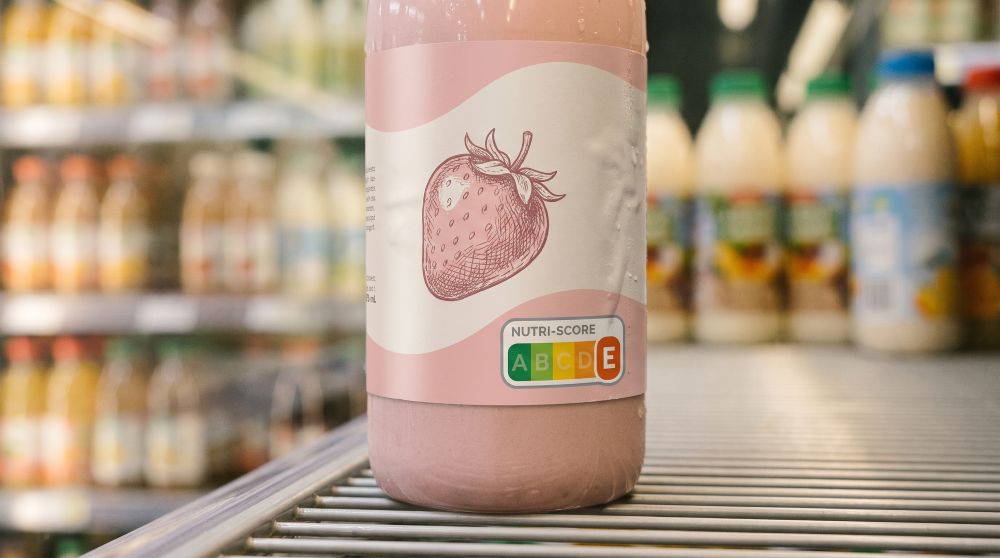
Actimel was a Nutri-Score B in Germany. Under the updated algorithm it's a Nutri-Score E, and Danone has taken the logo off the pack there. Pepsi Zero slipped from B to C. By February 2026, the consumer group Foodwatch counted 33 German manufacturers that had dropped Nutri-Score from some or all of their products.
If you sell into Europe, or plan to, this is the label your buyer will ask about. Here's how Nutri-Score works, what an E grade tells you, and why so many grades changed this year.
What is Nutri-Score?
Nutri-Score is a front-of-pack nutrition label used in several European countries. It gives a food or drink one of five grades, from A (dark green, the most favourable) to E (dark orange, the least favourable), based on its nutritional content per 100g or 100ml.
The grade compares products within the same category. It's most useful on a shelf of similar things: one breakfast cereal against another, one yoghurt drink against another. It isn't meant to compare a cereal with a cheese.
France introduced Nutri-Score in 2017. Belgium, Germany, Luxembourg, the Netherlands, Spain and Switzerland have since adopted it, all on a voluntary basis. Italy and several other EU countries oppose it, and there's still no single mandatory front-of-pack label across the EU.
It also comes from a familiar place. Nutri-Score is built on the UK Food Standards Agency (FSA) nutrient profiling model, the same family of model that sits behind the UK's HFSS (high fat, salt and sugar) rules. If you've ever run an NPM (Nutrient Profiling Model) check, the logic will look familiar.
How is Nutri-Score calculated?
Each product gets a points score, worked out per 100g or 100ml:
- Negative points come from energy, sugars, saturated fat and salt. For drinks, non-nutritive sweeteners now add negative points too.
- Positive points come from fibre, protein, and the share of fruit, vegetables, legumes and certain oils (rapeseed, walnut and olive).
- The final score is broadly negative points minus positive points. The lower the score, the better the grade.
Foods and drinks are graded on separate scales. Drinks run on a tighter one: water is the only drink that can get an A, and everything else sits between B and E. Cheese and added fats have their own calculation rules too.
What does Nutri-Score E mean?
Nutri-Score E is the lowest of the five grades. A product gets an E when it sits at the least favourable end of its category: high in energy, sugar, saturated fat or salt, with little fibre, protein or fruit and vegetable content to balance it out.
An E isn't a ban, and it isn't a verdict on whether the food belongs in a diet. Olive oil, cheese and chocolate can all land on D or E. It just tells a shopper that, among similar products, this one is the least favourable nutritionally.
Why did so many Nutri-Score grades drop in 2026?
The scientific committee behind Nutri-Score updated the algorithm for foods in 2022 and for drinks in 2023. Together these are known as the 2023 update, and it's the latest version of Nutri-Score: no newer revision has been published since.
Each country has phased it in on its own timeline. In Germany, products could carry grades from the old algorithm until the end of 2025, so from 1 January 2026 only the 2023 version counts. In France, the update was made official on 14 March 2025, and brands have two years from then to update their packs.
The main changes:
- Sugar and salt are scored more strictly. Products that sat just inside a better grade often slipped one.
- Milk drinks, yoghurt drinks and plant-based drinks now count as beverages, so they're scored on the stricter drinks scale. Sweetened flavoured milks that used to get A or B now mostly land on D or E. Oat, soy and almond drinks no longer get an A.
- Sweeteners now cost points in drinks. Swapping sugar for sweetener no longer buys a top grade, which is why Pepsi Zero moved from B to C.
- Fibre counts differently too, which moved grades in bread, prepared meals and some dairy alternatives.
So a brand that hasn't changed its recipe can still wake up with a worse grade. That's why big names are quietly taking the logo off: Danone on Alpro, Actimel and Fruchtzwerge, and PepsiCo on Pepsi, Mirinda and Rockstar (while keeping it on Lay's and Doritos).
Front-of-pack rules in the UK and EU keep shifting like this. The Bite is our free newsletter that sends the changes that matter for food brands every two weeks.
Is Nutri-Score mandatory?
Not yet, anywhere. The European Commission's position is that EU labelling law, the Food Information to Consumers Regulation (EU) No 1169/2011, only allows voluntary front-of-pack schemes unless the EU adopts one for everyone. So a single country can't simply make Nutri-Score mandatory on its own.
France has tried anyway. In November 2025, the French National Assembly voted to make Nutri-Score mandatory as part of the 2026 social security budget, with a 5% levy on companies that didn't display it. The Senate rejected it 212 to 117, and the Assembly then dropped it in second reading by 120 votes to 117. A similar amendment fell away from the 2025 budget too.
The push hasn't stopped. In May 2026, the scientists who created Nutri-Score filed a petition with the National Assembly to make it mandatory on food packaging in France. It had around 57,000 signatures and the backing of the Académie nationale de médecine, 45 companies, and consumer groups including UFC-Que Choisir and Foodwatch. A separate bill to make the label mandatory, filed in July 2025, is still waiting in committee. As of November 2026, Nutri-Score stays voluntary.
In practice, voluntary doesn't mean you can ignore it. If you sell in a country where shoppers are used to seeing the label, a missing grade gets noticed.
Do UK brands need Nutri-Score?
The UK doesn't use Nutri-Score. The government-recommended front-of-pack label here is the traffic light label, which colour-codes energy, fat, saturates, sugars and salt as red, amber or green. It's voluntary too, but most UK retailers and big brands use it.
Where Nutri-Score matters is export. If you're selling into France, Belgium, Germany or the Netherlands, or pitching to a European retailer or distributor, expect to be asked for your grade. A UK product with a perfectly fine traffic light label can still score a D or E, because the two systems weigh things differently and Nutri-Score grades within categories.
What to do if your product gets a Nutri-Score D or E
Start by working out why it scored what it did. A D or E usually comes from one or two nutrients doing most of the damage: salt in a savoury snack, saturated fat in a dairy dessert, sugar in a flavoured drink. Check the score line by line before you touch the recipe.
Then look at what's close. One extra gram of fibre or a small drop in salt can move a product up a full grade if it's sitting near a boundary. A product that's three points from the next grade is a very different brief from one that's twelve points away.
Finally, decide whether to show it. Some brands reformulate for a better grade; others, as Germany showed this year, take the label off where it hurts. Both are legal while the scheme stays voluntary, but if you drop the label, be ready for the buyer who asks anyway.
This is the kind of check Canoli is built for. It works as a Nutri-Score calculator for your recipes, using the latest (2023) algorithm, and shows the grade next to your UK nutrition panel and NPM score. You can see where you stand in both markets before anything goes to print, and try a recipe change to see how it moves the grade.
Want UK and EU regulatory and compliance updates for food brands in five minutes, every two weeks? Sign up to The Bite.
Frequently asked questions
What does Nutri-Score E mean?
Nutri-Score E is the lowest of the five grades (A to E) on the Nutri-Score front-of-pack label. It means the product has a less favourable nutritional profile than others in its category, usually because of high energy, sugar, saturated fat or salt per 100g.
How is Nutri-Score calculated?
Negative points are given for energy, sugars, saturated fat and salt (plus sweeteners in drinks). Positive points are given for fibre, protein, and fruit, vegetables, legumes and certain oils. Positive points are subtracted from negative points, and the total sets the grade. Foods and drinks are scored on separate scales.
What does Nutri-Score C mean?
C is the middle grade. The product is neither among the best nor the worst in its category. Under the 2023 algorithm, some diet soft drinks that used to get a B, such as Pepsi Zero, now sit at C.
Why did my product's Nutri-Score change?
Most likely because of the 2023 update, the latest version of the algorithm. Brands using the logo in Germany have had to switch to it since 1 January 2026, and French brands have two years from March 2025 to update their packs. It scores sugar and salt more strictly, moves milk and plant-based drinks into the beverage category, and penalises sweeteners in drinks. Products can drop a grade without any change to the recipe.
What is the Nutri-Score in France?
France created Nutri-Score in 2017 and was the first country to use it. It's a voluntary five-grade label (A to E) on the front of food packs. French brands that use it must follow the updated 2023 algorithm, made official by a government order on 14 March 2025, with two years to switch their packs.
Is Nutri-Score mandatory in the EU or France?
No. Nutri-Score is voluntary in every country that uses it. France's National Assembly voted for a mandatory version in November 2025, but it was removed from the final 2026 budget.
Is Nutri-Score used in the UK?
No. The UK uses the traffic light front-of-pack label. UK brands mainly need Nutri-Score when they export to, or sell through retailers in, countries such as France, Belgium, Germany and the Netherlands.
Nutri-Score isn't going away. It's still voluntary and still argued over, but it's the label European buyers look at first. Knowing your grade before they ask takes very little effort, and it's a lot better than finding out in a buyer meeting.
Try Canoli free for a month and check your Nutri-Score, traffic light label and NPM score in one place.