MSG in food: is it bad, is it banned and what to use instead
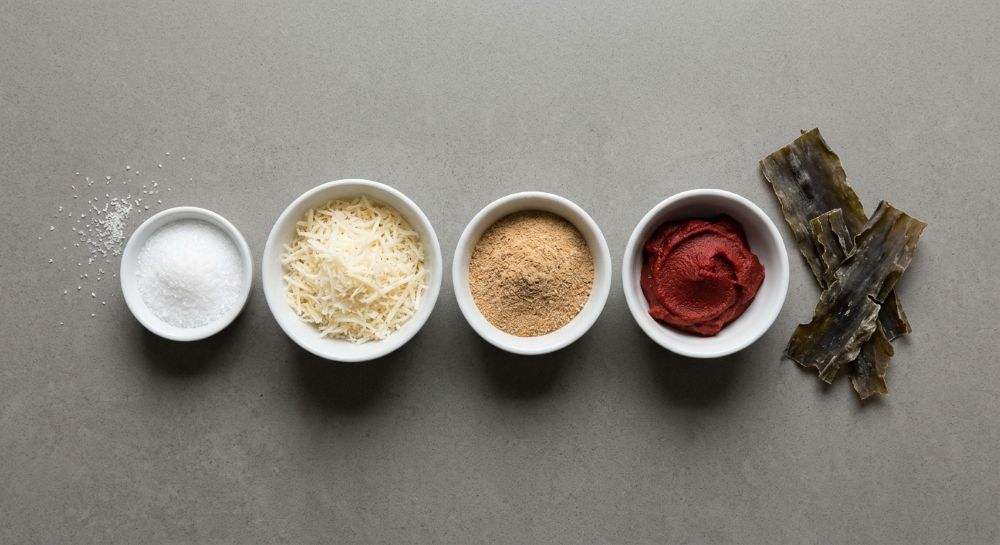
Pick up a tub of Knorr Aromat and the second ingredient after salt is "flavour enhancer (monosodium glutamate)". It's been on UK shelves for decades and it's completely legal. But in September 2026 Tesco banned monosodium glutamate (MSG) outright from its own-label range, and Waitrose's relaunched Good Health label wants no additives at all.
So if you make savoury food, sauces, snacks, soups or seasonings, there's a decent chance a buyer will ask you about MSG soon. This post covers MSG in food from both sides: what it is, whether it's bad for you, what UK law says as of October 2026, and what you can use instead without your salt and your label going sideways.
Is MSG banned in the UK?
No. MSG (E621) is a permitted food additive in Great Britain under retained Regulation (EC) No 1333/2008, the same rulebook as the EU. It belongs to a group of six glutamate additives, E620 to E625, which the Food Standards Agency's regulated products register lists as authorised in England, Scotland and Wales. Where they're permitted, most foods can use up to 10 g per kg, and seasonings, condiments and salt substitutes have no numerical limit beyond good manufacturing practice (known as "quantum satis").
What has changed is the retailer standard. Tesco named MSG alongside artificial colours and aspartame as fully excluded from own label when it expanded its restricted list to 114 additives on 11 September 2026 (FoodBev). That applies to Tesco's own brand only. Branded products can still use it.
On a label, MSG has to appear as its category name plus its name or E number, so "flavour enhancer (monosodium glutamate)" or "flavour enhancer (E621)" under the UK version of Regulation (EU) No 1169/2011, the food information rules.
Is MSG bad for you?
For most people, at normal levels in food, no. MSG's bad reputation goes back to April 1968, when a doctor called Robert Ho Man Kwok wrote to the New England Journal of Medicine about symptoms he got after eating at Chinese restaurants, and wondered whether salt, cooking wine or MSG was to blame. Newspapers turned it into "Chinese restaurant syndrome" (Science History Institute), and the label stuck. Regulators have looked at MSG many times since.
Food Standards Australia New Zealand (FSANZ) says MSG is considered safe and that JECFA, the joint World Health Organization and UN Food and Agriculture Organization expert committee, found it does not represent a health concern for the general population. A small number of people report short-lived symptoms like headache, flushing or tingling after large amounts in one meal. Health Canada notes the reported cases involved 3 to 5 g of MSG eaten on an empty stomach.
The European Food Safety Authority (EFSA) is a bit more cautious. In its 2017 re-evaluation it set a group acceptable daily intake (ADI) of 30 mg per kg of body weight per day for all six glutamate additives. That's about 2.1 g a day for a 70 kg adult. EFSA found that people with high intakes, and toddlers and children with medium intakes, may go over that, and it asked for maximum levels to be reviewed in soups and broths, sauces, seasonings and condiments, meat products, fine bakery wares and supplements.
For a food team, that matters more than the 1968 letter does. The categories EFSA flagged are exactly where small savoury brands use MSG, so the regulatory risk sits there, as well as the shopper perception.
Is MSG umami? What it actually does in a recipe
MSG is the sodium salt of glutamic acid, which is the amino acid behind umami, the savoury taste. Commercial MSG is made by fermenting starch, sugar beet or molasses with bacteria, not extracted from seaweed as people sometimes assume.
Your tongue can't tell added glutamate from the glutamate already in food, and plenty of everyday ingredients are full of it. Figures from the Academy of Nutrition and Dietetics' Umami in Foods white paper put free glutamate at 1,200 to 1,680 mg per 100 g in Parmesan, 412 to 1,264 mg in soy sauce, 140 to 246 mg in tomatoes and 150 mg in dried shiitake. Human breast milk has about 19 mg per 100 ml.
There's also a sodium angle that often gets missed. By weight, MSG is roughly 12% sodium, against about 39% in table salt, according to USDA (United States Department of Agriculture) figures quoted by MSG maker Ajinomoto. That's why it gets used in salt reduction: a pinch of MSG lets you take some salt out without the food tasting flat. Take the MSG out and the obvious fix is to put salt back in, which pushes up your sodium, your traffic light for salt and your NPM score (the Nutrient Profiling Model used to decide whether a product is HFSS, or high in fat, salt or sugar). Our HFSS scoring walkthrough shows how a single salt band can tip that score.
Why retailers are taking it out anyway
If it's legal and safe at normal levels, why ban it? Shoppers. Tesco says 81% of its customers are trying to cut down on ultra-processed food (UPF), and flavour enhancers are one of the additive groups that NOVA, the classification most UPF research uses, treats as a marker of ultra-processing. NOVA lists them with flavours, colours and emulsifiers as "additives with cosmetic functions" (Nova classification). An E number on the back of pack is an easy thing for a shopper, or an app, to screen out.
We covered the wider picture in Tesco and Waitrose additive bans: what it means for your recipe and how NOVA draws its lines in What counts as ultra-processed food?. The short version is that this is a commercial standard, it's moving faster than the law, and it reaches suppliers through spec reviews.
MSG alternatives: what to use instead
None of these is a straight one-for-one swap. Each brings glutamate, but each also brings its own flavour, salt, colour or allergen, and those are what decide whether the reformulation works.
| Alternative | What it brings | How it's labelled | Watch out for |
|---|---|---|---|
| Yeast extract | Free glutamate plus nucleotides, so a strong savoury hit | "Yeast extract", an ingredient, not an additive | Its own sodium; a "hidden MSG" criticism from some shoppers; check it isn't on your buyer's list |
| Tomato paste or powder | Moderate glutamate, body, sweetness | "Tomato paste" / "tomato powder" | Colour and acidity, which can clash in cream or white sauces |
| Dried mushroom powder (e.g. shiitake) | Earthy umami, about 150 mg free glutamate per 100 g dried | "Mushroom powder" | Brown colour and a distinct mushroom note at higher inclusion |
| Kombu and other seaweeds | High natural glutamate | "Kombu" / "seaweed" | Iodine content varies a lot between batches, so get it on the supplier spec |
| Aged cheese (e.g. Parmesan) | 1,200 to 1,680 mg free glutamate per 100 g | "Cheese (milk)" | Milk allergen, plus saturated fat and salt that move your NPM score |
| Soy sauce or miso | High glutamate and fermented depth | "Soy sauce (water, soybeans, wheat, salt)" | Soy and often gluten allergens, and a lot of salt |
| Hydrolysed vegetable protein | Glutamate released from the protein | "Hydrolysed vegetable protein" (plus the source, e.g. soy) | Allergen from the source protein, and the same "hidden MSG" criticism as yeast extract |
In practice most teams combine two or three of these. Tomato and mushroom with a little yeast extract gets closer to MSG's effect than any one of them alone, because glutamate and nucleotides boost each other. The two nucleotide additives that do this on their own, disodium guanylate (E627) and disodium inosinate (E631), are additives too, so they're unlikely to help with an "additive-free" brief.
Whatever you pick, recalculate the nutrition panel from the new recipe before you trial it. If you're unsure whether a calculation is enough, Do you need lab testing for a UK nutrition label? walks through it.
Can you say "no added MSG" on pack?
Be careful. The UK has no specific rule on "no added MSG", so the claim falls under the general test in Article 7 of the food information rules: information must not mislead. Article 7 also says you can't imply a product is special when all similar foods share the same characteristic, so "no added MSG" on a crisp flavour that never contained it is already on shaky ground.
The bigger risk is swapping MSG for yeast extract or hydrolysed protein and then shouting about it. Health Canada says plainly that "no added MSG" is misleading when a food contains other glutamate sources like these. UK rules aren't identical, but a trading standards officer, a buyer or a shopper with a label app could reach the same view. The safer route is to let the shorter ingredient list do the talking.
What this means for a food team
If you supply Tesco own label, MSG is already out of your spec. If you're a branded supplier, nothing applies to you directly, but a buyer review is a reasonable place to expect the question.
Either way, the work looks the same:
- List every SKU (stock keeping unit) containing E620 to E625, E627, E631 or E635.
- For each one, note what the MSG was doing. Was it a flavour boost, or was it quietly holding the salt down?
- Pick your replacement blend and recalculate sodium, the salt traffic light, the NPM score and the allergen declaration together, not one at a time.
- Run a sensory check against the current product, then a shelf-life check if you've added a fresh-style ingredient like tomato or cheese.
The trap is doing step 3 in four separate spreadsheets. A swap that fixes the label can add an allergen, turn the salt light red or push a product into HFSS, and you usually find out after the trial.
Frequently asked questions
Is MSG banned in the UK?
No. Monosodium glutamate (E621) is a permitted additive in Great Britain under retained Regulation (EC) No 1333/2008. Tesco has banned it from its own-label range as of September 2026, but that's a retailer policy, not law, and branded products can still use it.
Is MSG bad for you?
At normal levels in food, regulators including FSANZ and JECFA say MSG is safe for the general population. EFSA set an acceptable daily intake of 30 mg per kg of body weight per day in 2017 and flagged that high consumers may exceed it. Some people report short-lived symptoms after large doses, around 3 to 5 g on an empty stomach.
Is MSG umami?
Yes. MSG is the sodium salt of glutamic acid, and glutamate is what gives the umami, or savoury, taste. The same glutamate occurs naturally in Parmesan, tomatoes, soy sauce and mushrooms, and your body handles it the same way.
Is Aromat MSG?
Knorr Aromat contains MSG but isn't pure MSG. Its ingredient list starts with salt, then "flavour enhancer (monosodium glutamate)", followed by lactose, onion powder, yeast extract and spices.
Is yeast extract the same as MSG?
No. Yeast extract is an ingredient, not an additive, and it's declared as "yeast extract" rather than with an E number. It does contain free glutamate and nucleotides, which is why it tastes savoury, and why some shoppers call it "hidden MSG".
What is MSG made of?
Commercial MSG is made by fermenting starch, sugar beet or molasses with bacteria to produce glutamic acid, which is then turned into its sodium salt. It contains about 12% sodium by weight, roughly a third of the sodium in table salt.
What can I use instead of MSG?
Yeast extract, tomato paste, dried mushroom powder, kombu, aged cheese, soy sauce and hydrolysed vegetable protein all bring natural glutamate. Most teams blend two or three. Each one changes salt, allergens or colour, so recalculate the label after the swap.
How much MSG is allowed in food?
In Great Britain, most foods permitted to contain glutamates can use up to 10 g per kg. Seasonings, condiments and salt substitutes have no set maximum beyond good manufacturing practice. EFSA has recommended these limits be reviewed for several savoury categories.
MSG is one of the clearest cases of a legal, well-studied ingredient being pushed out by shopper perception rather than regulation. EFSA has asked for the limits to be reviewed, so the perception gap may narrow, or the rules may tighten. Either way, it's worth knowing which of your products depend on it before a buyer asks.
Canoli recalculates your nutrition, NPM score, traffic lights and allergens as you swap ingredients, so you can test an MSG-free recipe before you book the trial. Get started free.