Tesco and Waitrose additive bans: what it means for your recipe
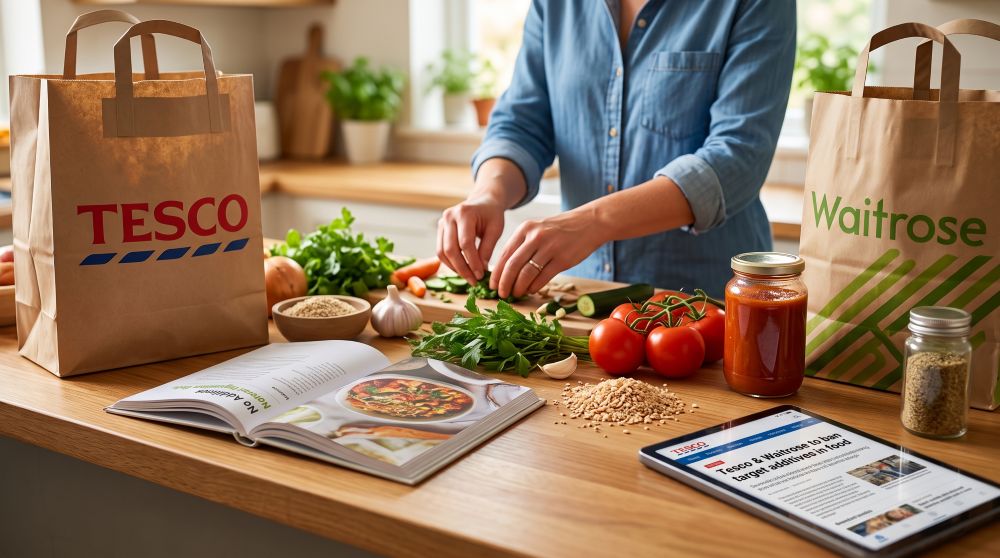
Tesco's additive ban now covers 114 additives across its own-label range, either banned outright or restricted, as part of a push against ultra-processed food. A year ago the list had 65 on it. Three weeks after Tesco's 11 September announcement, Waitrose relaunched its Good Health label. To carry the logo, a product now needs no additives, or only ingredients a shopper would recognise, and it also has to be non-HFSS (high in fat, salt or sugar) with no red traffic lights.
Neither of these is the law. Every additive on those lists is still legal in the UK. But if you make own label for either retailer, or you want shelf space next to it, the brief has changed.
Why retailers are banning additives now
The short answer is shoppers. Tesco says 81% of its customers are trying to cut down on ultra-processed food (UPF). Waitrose says 93% of its "Food Lovers" shoppers prioritise avoiding it and check ingredient lists. Tesco has also added an online filter so shoppers on tesco.com can search for products without additives. Retailers are also already reporting how healthy their sales are (Tesco says 65% of its UK and Republic of Ireland food sales are classed as healthy), which ties into the government's plans for mandatory healthy food sales reporting.
The longer answer is that nobody has defined UPF in law, so retailers are writing their own definitions. The Scientific Advisory Committee on Nutrition (SACN), which advises the UK government, said in its April 2025 evidence update on processed foods that most UPF research is observational. It can't yet show whether processing itself causes harm, or whether UPFs are simply higher in calories, saturated fat, salt and sugar. SACN also noted that NOVA, the classification most UPF studies use, puts some foods in categories that clash with nutrition-based ones.
So, as of October 2026, there is no UK legal definition of ultra-processed food. Additives are still regulated under retained Regulation (EC) No 1333/2008, and approved additives are safety assessed. What's moving is the commercial standard, and it's moving faster than the regulation.
For a supplier, that means the change arrives through a spec review, without the consultation period a new regulation would come with.
What Tesco and Waitrose are actually asking for
The two retailers are not asking for the same thing.
Tesco (announced 11 September 2026)
- 114 additives banned or restricted in own label, up from 65 last year
- Banned outright: artificial colours, aspartame, and monosodium glutamate (MSG)
- Restricted and flagged for supplier work: mono- and diglycerides of fatty acids (E471)
- Everything else: use familiar "kitchen cupboard" ingredients where possible, and keep additives to the minimum needed for food safety, shelf life and quality
Tesco hasn't published the full list publicly, so if you supply own label, ask your Tesco technical contact for it. Don't work from press coverage.
Waitrose Good Health (announced 1 October 2026)
To carry the logo, a product has to pass two tests together:
- Ingredients: no additives, or only ingredients that are easy to recognise
- Nutrition: at least one valid nutrition or health claim, non-HFSS under the nutrient profiling model (NPM), and no red traffic lights. Naturally occurring fats and sugars (nuts, seeds, milk, fish, fruit) are exempt from the red light rule, and an amber for saturated fat is allowed only if no saturated fat has been added
Waitrose says it has already reformulated 110 own-label products and removed 220 additives over the past 20 months.
The Waitrose brief is harder. Tesco wants additives out; Waitrose wants them out while the product stays non-HFSS and still earns a claim.
The four additive groups most likely to come out first
Tesco has named four groups so far, and they're a sensible place to start checking your own range.
Artificial colours
These are usually the easiest swap. Colouring foods (concentrates of beetroot, carrot, spirulina, black carrot and similar) can often replace synthetic colours. Under the European Commission's 2013 guidance notes on colouring foods, a concentrate made without selectively extracting the pigment is treated as a food ingredient rather than an additive. The guidance isn't law, so confirm the classification with your supplier. The trade-off is stability. Natural pigments are more sensitive to heat, light and pH, so check colour across the full shelf life, not just on day one.
Aspartame
This is where an additive ban runs into HFSS. Take the sweetener out and you have three options: switch to another sweetener (if it isn't also on the list), accept a less sweet product, or put sugar back in. The third option pushes up your NPM score and, in soft drinks, can bring you into the Soft Drinks Industry Levy. Model the sugar before you brief the trial.
MSG
The usual route is savoury ingredients that bring natural glutamates, such as yeast extract, tomato concentrate, mushroom powder or aged cheese. They work, but they bring their own sodium and flavour notes, so watch salt and recheck your red traffic light for salt.
Mono- and diglycerides (E471)
This is the hardest of the four. In bread and cakes, E471 keeps the crumb soft and slows staling. In ice cream and spreads, it holds the emulsion together. Bakeries often replace it with enzymes, such as maltogenic amylase for anti-staling. The Federation of Bakers notes that enzymes used in bread are deactivated by baking, so they don't need to be listed on the label. That makes the label shorter, but keep a record of what's in the process, because a buyer may still ask.
What changes when you take an additive out
Each additive was in the recipe to do a job. Take it out and something else has to do that job, or the product changes. In practice, three things move almost every time.
- Shelf life. Preservatives, emulsifiers and stabilisers all affect how a product holds up. A bread that went 7 days without mould or staling might now go 5. Run a shelf-life trial before you change the date code.
- The nutrition panel. Swapping MSG for cheese or yeast extract changes the salt. Swapping a sweetener for sugar changes the sugar and the energy. Recalculate the panel from the new recipe. For when a calculation is enough and when to pay for a lab, read Do you need lab testing for a UK nutrition label?
- The HFSS score. Any change to sugar, salt, fat or energy moves your NPM score. If you're close to the threshold of 4 points for food or 1 for drink, a cleaner label can tip you into HFSS. Our HFSS scoring walkthrough shows how a single band can make that difference.
What this means for a food team
If you supply own label to Tesco or Waitrose, this is already in your spec. Get the full additive list from your technical contact, map every SKU (stock keeping unit) against it, and rank them by how hard the swap is. Colours first, emulsifiers last.
If you're a branded supplier, nothing applies to you directly yet. But you're sitting next to own-label products that now carry shorter ingredient lists, and Tesco's online filter lets shoppers screen out products with additives. A buyer review is a reasonable place to expect the question.
Either way, it helps to treat this as more than a clean label project. The same change touches shelf life, the nutrition panel, the HFSS score and any claim on pack. If those four are worked out in separate spreadsheets, you'll find the problem at the end, usually when the product has already been trialled. Work them out together, from the recipe, before you book the trial. If you're cutting sugar at the same time, our guide to clean label sugar reduction covers what works without adding new E-numbers.
Frequently asked questions
Is there a legal definition of ultra-processed food in the UK?
No. As of October 2026, there is no UK legal definition of ultra-processed food. SACN's April 2025 evidence update found that most research links higher UPF intake with poorer health, but the evidence is mainly observational and can't show cause and effect. Retailers like Tesco and Waitrose are setting their own standards in the meantime.
Which additives has Tesco banned?
Tesco's own-label policy covers 114 additives, banned or restricted, up from 65 in 2025. It has named artificial colours, aspartame and monosodium glutamate as fully excluded, and mono- and diglycerides of fatty acids (E471) as restricted. The full list goes to suppliers and hasn't been published.
Does Tesco's additive ban apply to branded products?
No. The policy covers Tesco's own-label range only. Branded products can still use any additive permitted under UK law. Tesco's online filter for products without additives does let shoppers screen across what's on tesco.com.
What do you need for the Waitrose Good Health label?
A product needs no additives or only easily recognised ingredients, at least one valid nutrition or health claim, non-HFSS status, and no red traffic lights. Naturally occurring fats and sugars are exempt from the red light rule. Both the ingredient and nutrition criteria have to be met.
What can replace E471 in bread?
Bakeries usually replace mono- and diglycerides (E471) with enzymes, such as maltogenic amylase, to keep the crumb soft and slow staling. Enzymes used in bread are deactivated by baking, so they don't need to appear on the label. Run a shelf-life trial, because the softness profile over the shelf life can change.
Are food additives unsafe?
Additives permitted in the UK are safety assessed and authorised under retained Regulation (EC) No 1333/2008, with set conditions of use. The retailer bans are a response to shopper demand around ultra-processed food, not a change in the legal safety status of the additives.
Tesco hasn't published its full list and Waitrose hasn't given a rollout date, so expect more detail to land through spec reviews over the next few months. It's worth mapping your range against the named additives now, before that happens.
Canoli shows what happens to your nutrition, NPM score and claims as you swap ingredients, so you can test a cleaner recipe before you trial it. Get started free.