From flat kitchen to label: what two London founders learned about nutrition labels
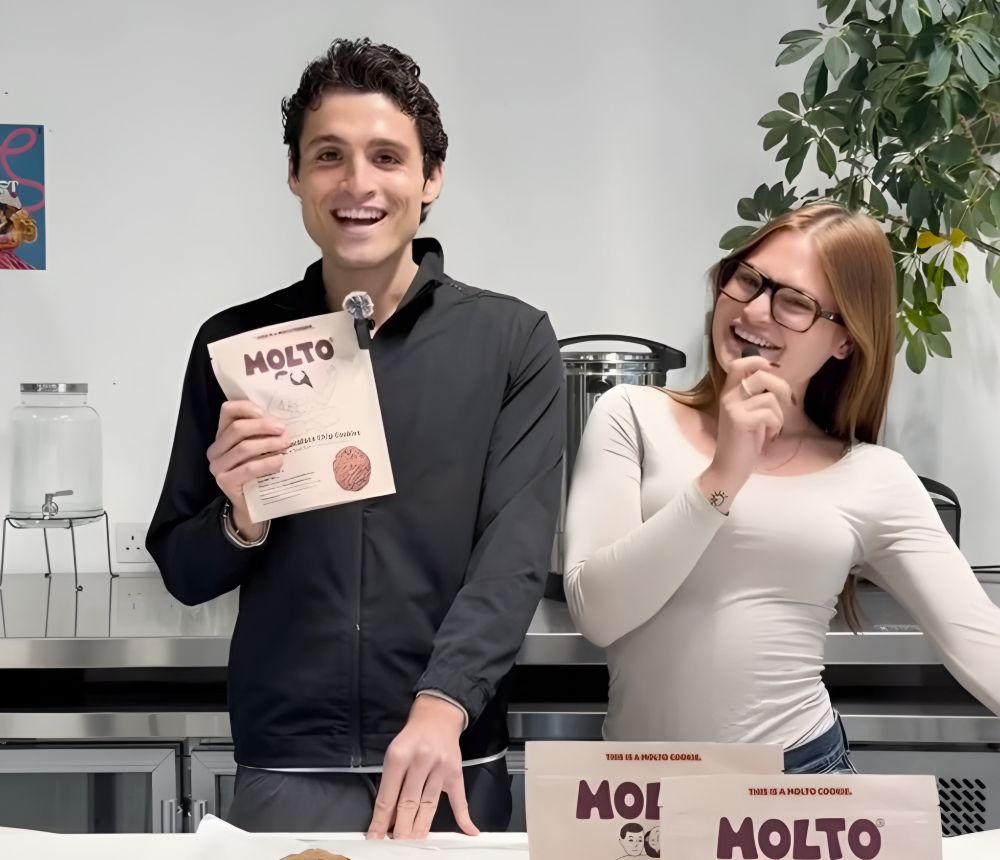
Kitchen to Label is Canoli's series on small food and drink founders and the part of their story that happens before a product reaches the shelf. This episode features Virgilio Guidi and Sofia, co-founders of MOLTO. You can find them at justmolto.com and on Instagram at @justmolto.
Know a founder with a kitchen-to-label story? Tell us about them and they could be next.
Where it started
For years, Virgilio and Sofia's Sundays looked the same. They were flatmates in London, and once a week they'd warm a cookie in the microwave for about 30 seconds until the middle went soft, add a scoop of Häagen-Dazs and share it. Somewhere along the way it became their favourite part of the week.
They loved everything about it apart from the ingredients. When they worked it out, their usual Sunday treat contained roughly 44g of sugar. As they put it: "We didn't want to stop having it. We just wondered whether we could make something equally indulgent, using ingredients we actually wanted to eat."

Version one
The experiments started in their flat. The first cookies used almond flour, oats, cassava, dates, butter and dark chocolate, with a tiny amount of white miso. Some early versions tasted far too much of dates, others turned rubbery when they were warmed, and some were so soft they reminded them more of an Italian plumcake than a cookie.
The number that changed the recipe
One of their earliest shocks came when they properly calculated the nutritional information. They'd been working with an estimate of around 155 calories per cookie, but when they went back through the actual ingredient labels, that recipe was closer to 420. The almond flour alone contributed roughly 1,000 calories to the batch.
That sent them down a rabbit hole with dried sweet potato, which they added to reduce their reliance on almond flour and bring the calories down. Nobody could taste it, and the cookies still looked and tasted good. They decided against it anyway. Once they imagined explaining why there was sweet potato in their cookies, the whole thing started to sound more like a health product than the indulgent dessert they wanted to make.
"That experiment taught us something important: we weren't trying to make the lowest-calorie cookie possible. We wanted to make a genuinely wonderful cookie using ingredients we felt good about."
Getting the texture right
Texture was their biggest obsession. Too much cassava flour made the cookie rubbery when reheated, and too little meant it fell apart. Small changes mattered a lot: simply halving the bicarbonate made a surprisingly big difference, and the chocolate only behaved once they switched to evenly sized drops.
The ingredient people are most surprised by is white miso. You can't taste it in the finished cookie, but a little of it deepens the chocolate, brings out the caramel notes from the dates and honey, and makes the sweetness feel more complete.
From the flat to a commercial kitchen
Going from baking at home to producing something people could buy was, in their words, "a completely different education."
"I'll never forget our first session in a commercial kitchen. I had absolutely no idea how to use the enormous planetary mixer. I put everything inside, switched it on, and the dough went flying EVERYWHERE. And I genuinely mean everywhere."
Production also demanded a new level of precision. They'd assumed an egg yolk weighed about 15g, only to find theirs were closer to 18g, and that difference matters when you're trying to make the same cookie every time. Even supplier paperwork surprised them: one specification sheet for their date paste listed 1g of fat per 100g, while the actual packaging said 10g.
"Suddenly, understanding nutritional declarations, checking specifications and getting our labels right became just as important as getting the recipe right."
Storage trials, packaging, food safety, allergen declarations and making sure every batch met the same standard all followed, none of which they'd thought about when they were making cookies for themselves on Sundays.
Surprises like these usually only show up once you check every label and spec sheet. See what your own recipe really adds up to in Canoli →
The dinner party test
One of their favourite moments came at a dinner party, when they put the cookies out and most guests didn't know they were building a business. Theirs were the ones that disappeared, and one guest tried another bakery's cookie afterwards and couldn't finish it because it tasted too sweet.
"We'd spent so long worrying about whether the cookies were good for what they were made from. We wanted people to love them simply because they were delicious."
MOLTO today
MOLTO launched on 17 June 2026. The cookies are made by hand in small batches in London, with the dough frozen raw and baked fresh, and they're made without refined sugar, using dates, honey and dark chocolate that contains coconut sugar. So far they've sold more than 1,300 cookies through their website, pop-ups, wellness events and workplace activations.
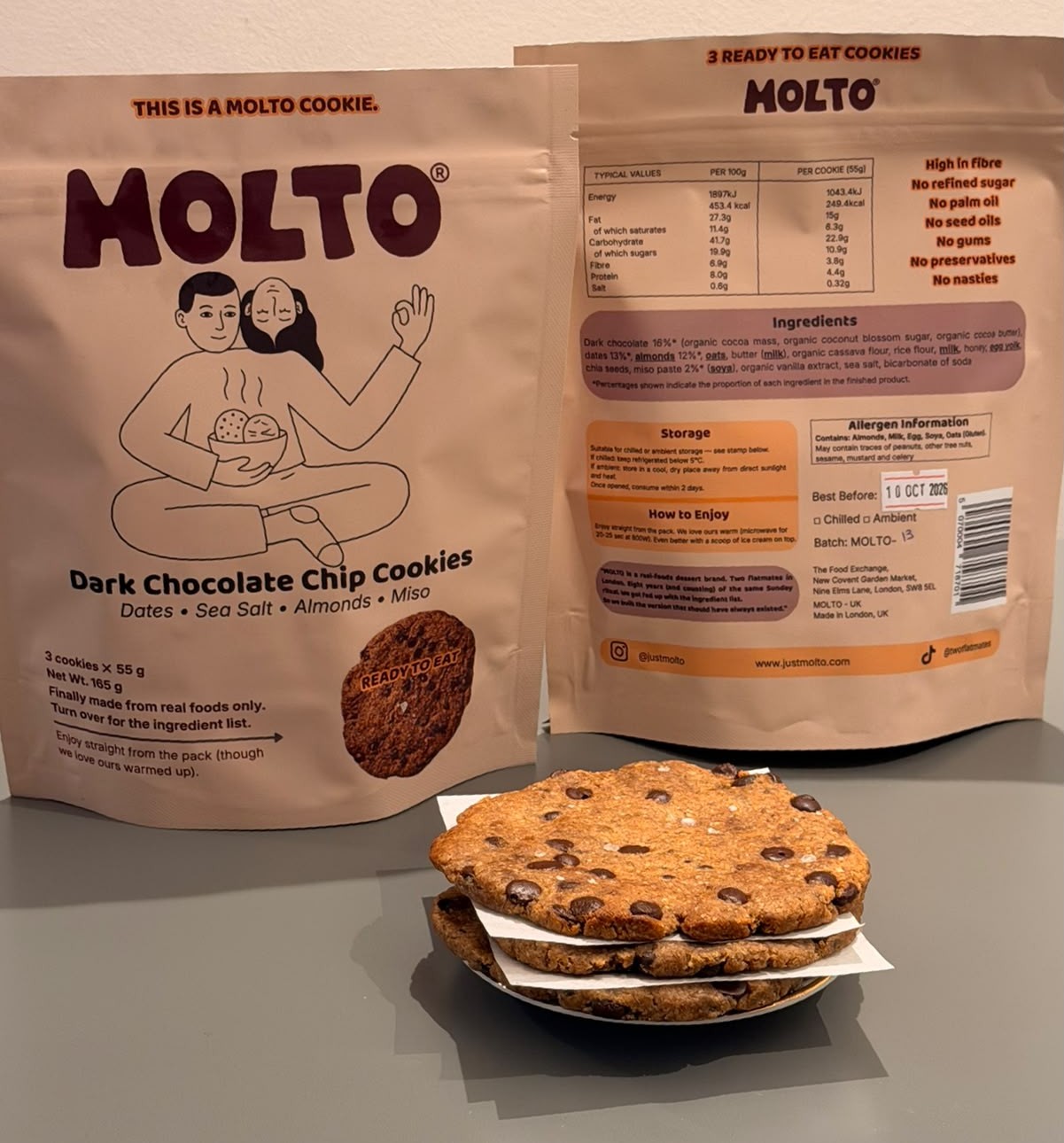
The packaging carries the story too. The illustrated pouch holds three cookies, and on the front are two figures sharing one body, completely at ease, holding a bowl of warm cookies and cold ice cream. One has their head tilted and eyes closed, the other is looking ahead, and the comfy clothes and patterned socks are a nod to those ordinary Sundays at home.
The other half of the ritual
The one part of the original ritual they haven't brought to market is the ice cream. Getting the texture right has been more complicated than they imagined, but they're still working on it. Over the next few years, they'd love to see MOLTO in the independent shops they admire and eventually bring the ice cream to the table too.
Until then, they still eat their cookies the way they always have: warm, with something cold on top, together on a Sunday.
"MOLTO means 'very much' in Italian. We never wanted to create a dessert that asks you to want less of it"
Kitchen notes for other founders
- Work out your nutrition from real ingredient labels, not estimates. The gap can be bigger than you'd expect.
- Let people taste it before they know the story. Their honest reaction tells you more than any compliment.
- Cross-check supplier spec sheets against the pack. Your label is only as accurate as the data behind it.
- Decide what your product is. A swap can work technically and still pull the product somewhere you don't want it to go.
FAQs
How do you calculate calories for a homemade recipe?
Add up the nutrition of every ingredient, using the figures from its own label or spec sheet and the exact weight you use in grams. Then divide the batch total by the number of cookies it makes. Estimates based on rough or generic values can be a long way off, so check each ingredient's real data. Canoli does this maths for you from your recipe.
What is a spec sheet?
A spec sheet (short for product specification) is the document a supplier gives you for each ingredient. It lists what's in it, its nutrition per 100g, allergens, and how to store it. Food brands use spec sheets to work out their own nutrition and allergen information, so it's worth checking the figures match the pack before you rely on them for your label.
Is coconut sugar a refined sugar?
Not usually. Coconut sugar is made by heating the sap of the coconut palm until it crystallises, so it goes through far less processing than white sugar and is often described as unrefined. It's still sugar, though, and like dates and honey, it counts towards the total sugars on a nutrition label.
Find MOLTO at justmolto.com and on Instagram at @justmolto.
Taking a recipe from your kitchen to the label? Check your real nutrition numbers before your first label goes to print →